
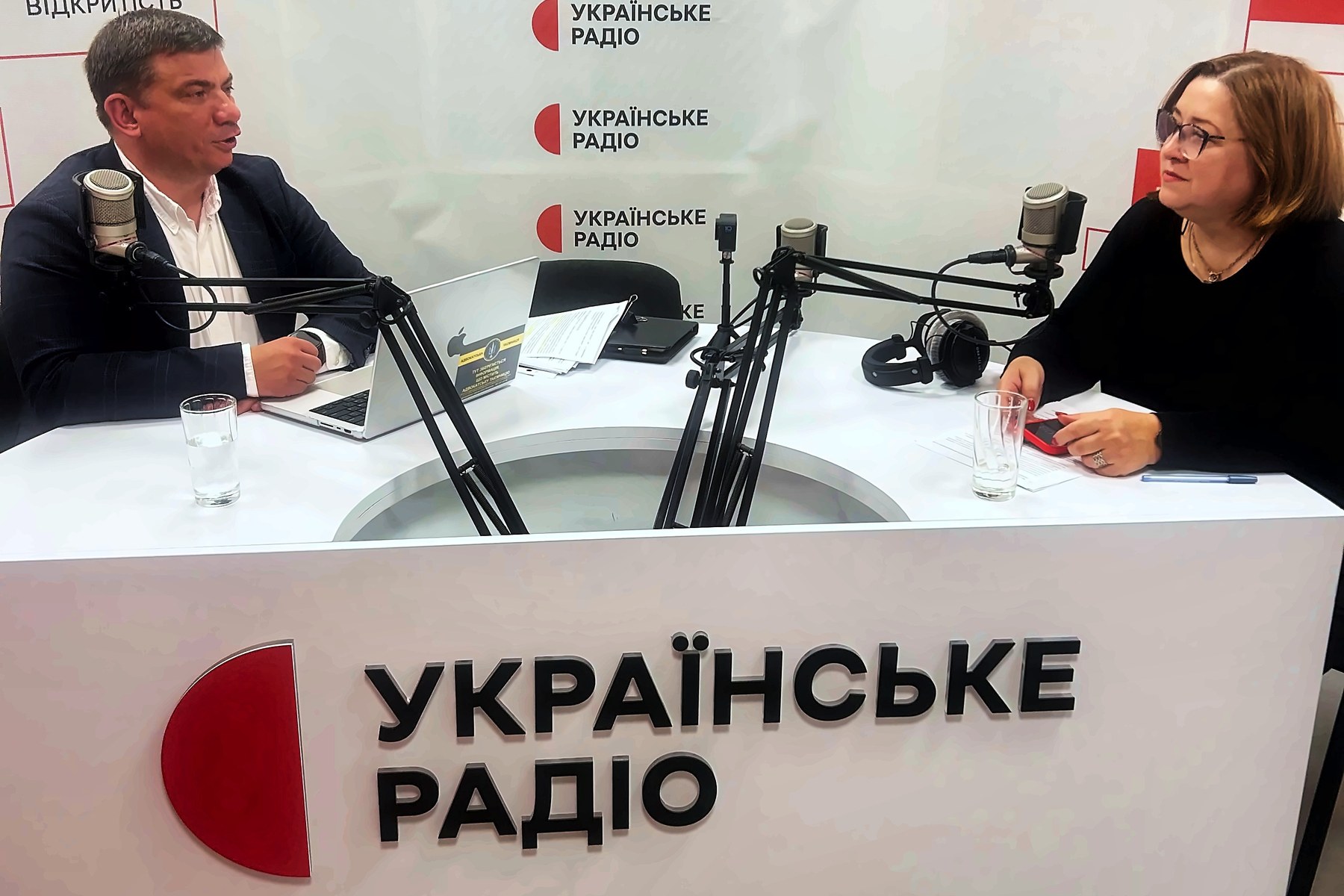
On 20 September 2026 Yurii Bauman, Managing Partner of Bauman Kondratyuk Attorneys Association, was the guest of «Tvoye Pravo» (Your Right), the legal affairs programme of Ukrainian Radio, the country’s public broadcaster. The 39-minute conversation with host Nataliia Paraka addressed compensation from the State — a question that matters to every business and every citizen who has ever been on the wrong end of a state decision: does the State actually pay for the mistakes of its officials, and what are the realistic odds of not merely winning in court but collecting the money awarded?
What the conversation was about
The discussion turned on a simple proposition: the State pays for paperwork, not for pain. Article 56 of the Constitution of Ukraine guarantees everyone compensation for damage caused by unlawful decisions, acts or omissions of public authorities and their officials, and the Civil Code (Articles 1173, 1174 and 1176) places that liability on the State regardless of whether the individual official was at fault. Between the right to compensation and the money arriving in a bank account, however, lies a chain of procedures in which most claimants make the same mistakes: they fail to document their losses from day one, they sign a “no claims” acknowledgement when seized property is returned, they present the judgment for enforcement late, and they never claim compensation for the State’s delay in paying.
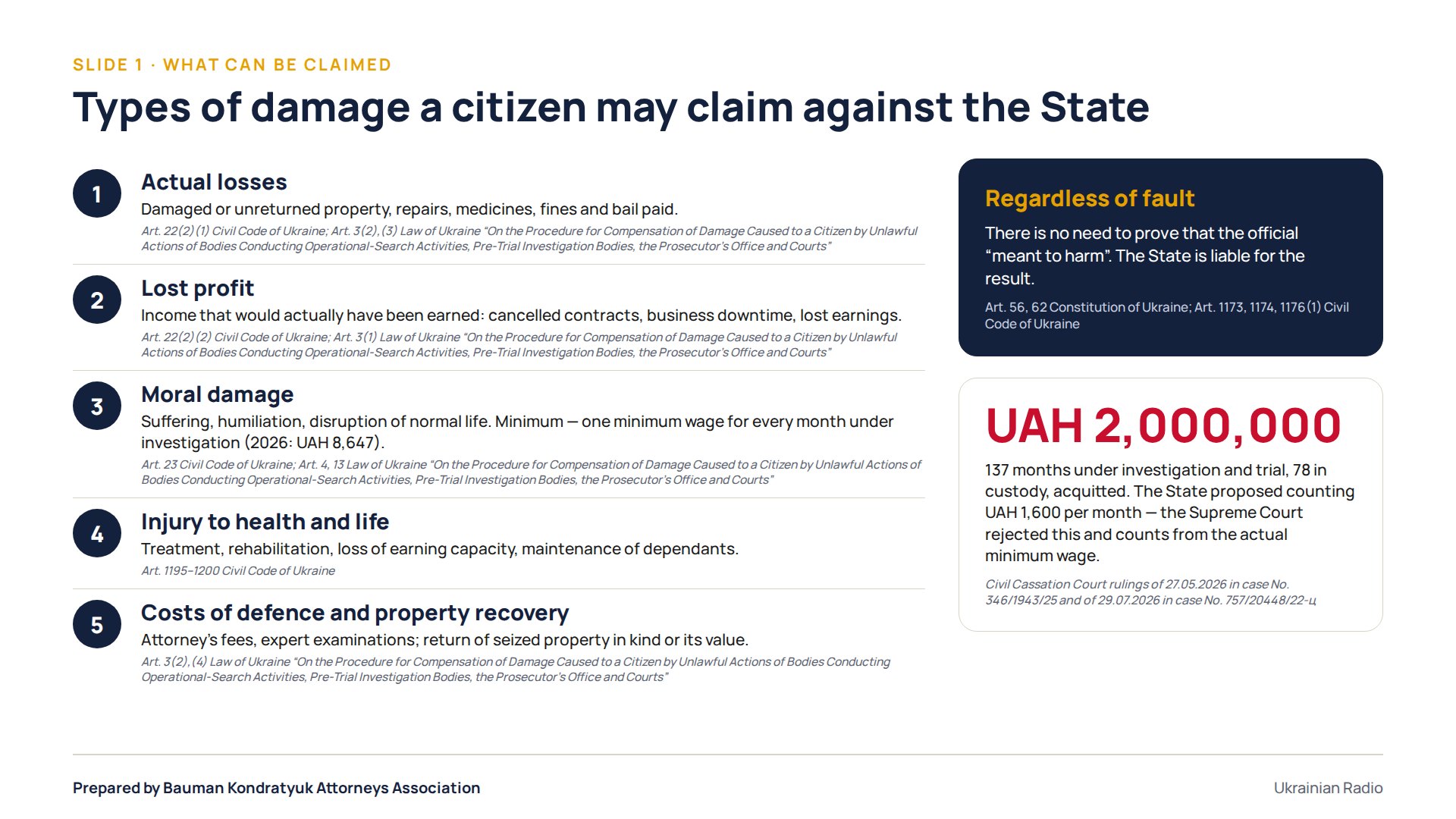
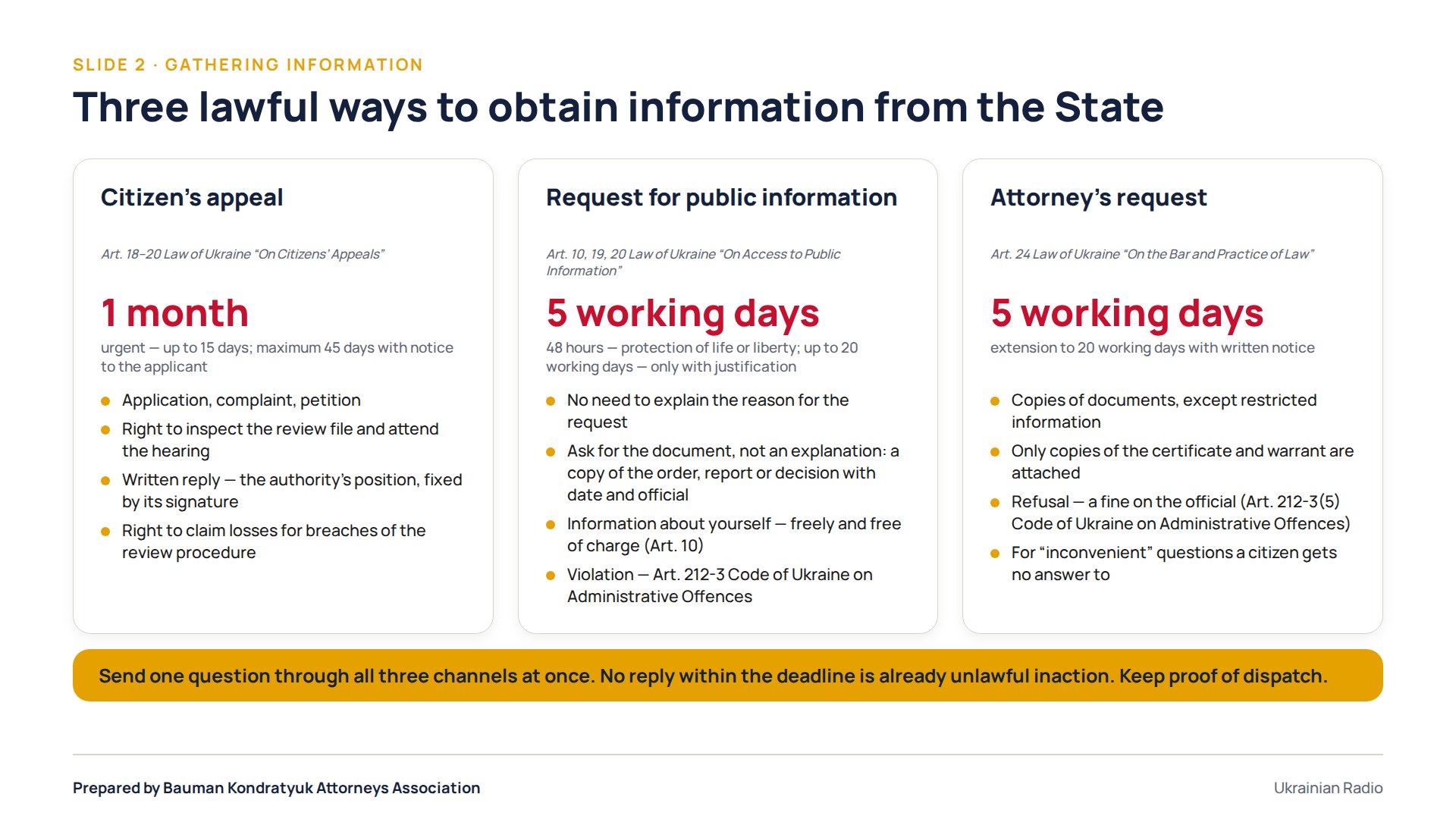
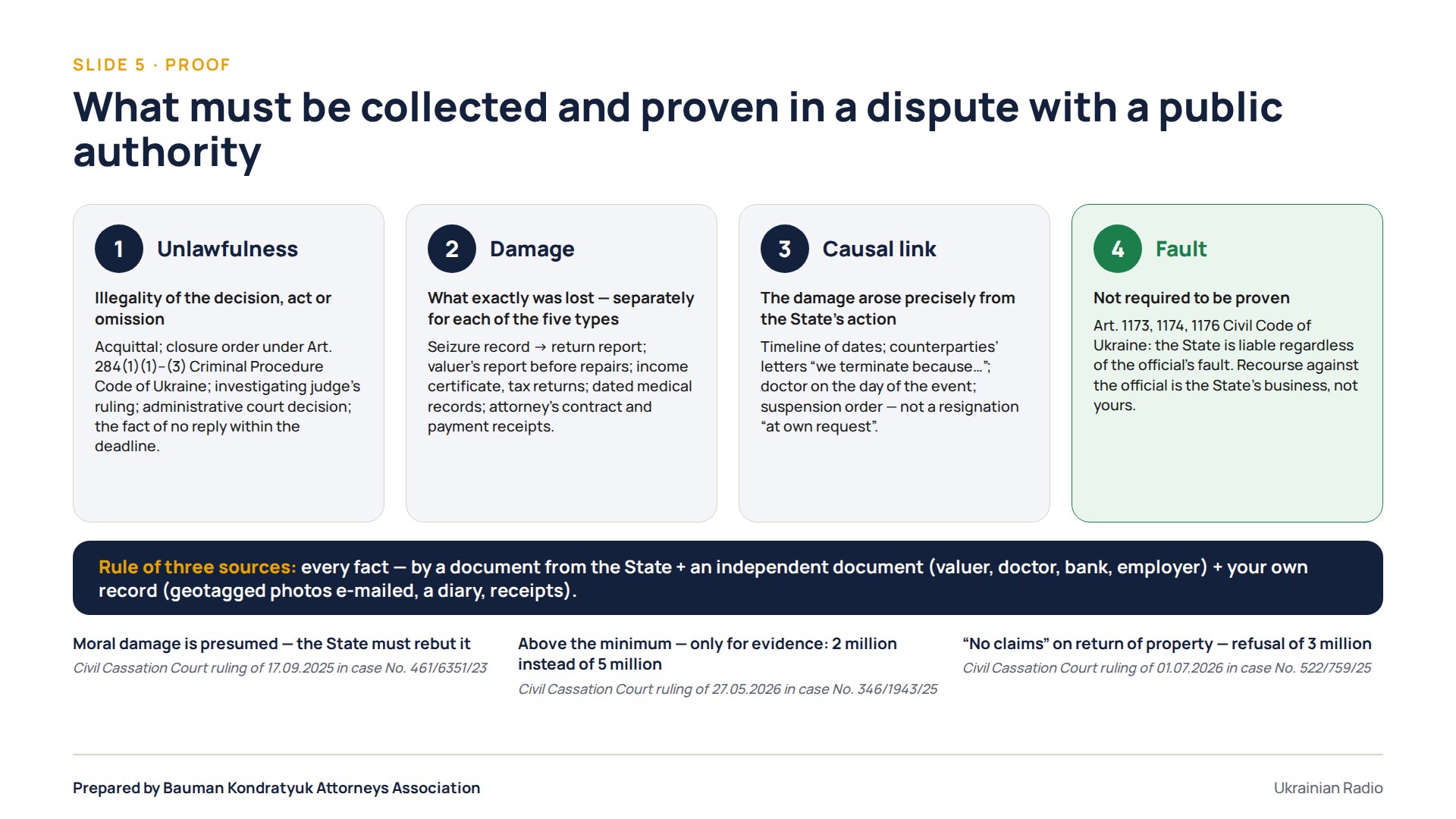
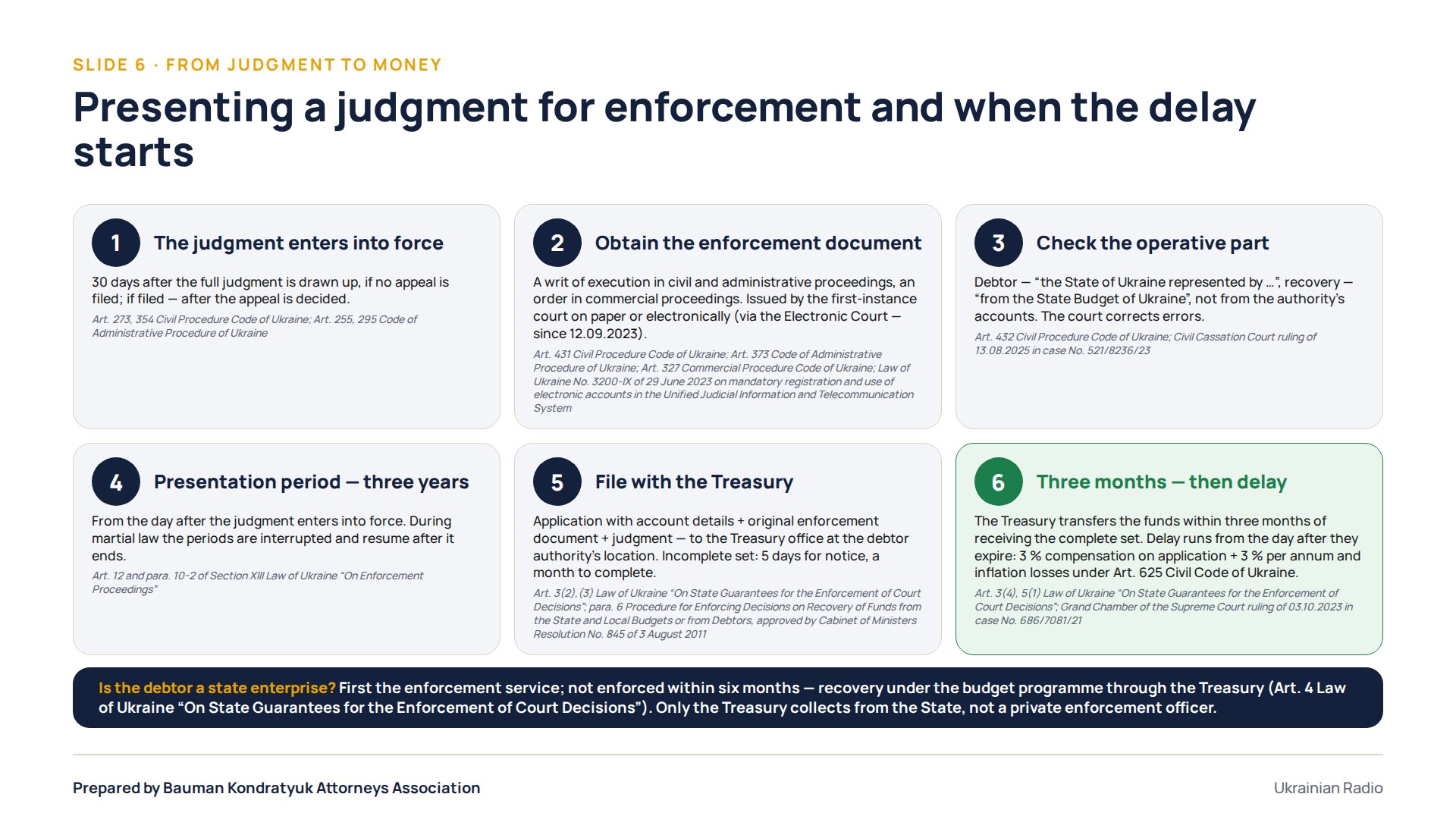
Mr Bauman walked listeners through the five heads of damage that may be claimed against the State (actual losses, lost profit, moral damage, injury to health and life, and the costs of legal defence and property recovery), the three lawful instruments for extracting information from a public authority and the statutory deadlines attached to each (a citizen’s appeal, a request for public information, and an attorney’s request), the elements that must be proven in a claim against the State, and the step-by-step procedure for presenting a judgment for enforcement through the State Treasury Service, including the exact moment from which the delay starts to run and 3 % per annum and inflation losses become payable.
Three Supreme Court cases discussed on air
UAH 2,000,000 for 137 months under investigation. A man was charged with murder, spent 137 months under investigation and trial, 78 of them in custody, and was ultimately acquitted. The State argued that moral damage should be calculated from a notional “reference value” of UAH 1,600 per month. The Civil Cassation Court of the Supreme Court rejected that approach and confirmed that the statutory minimum is calculated from the actual minimum wage for every month of unlawful prosecution, while any award above the minimum must be supported by evidence (rulings of the Civil Cassation Court of 27 May 2026 in case No. 346/1943/25 and of 29 July 2026 in case No. 757/20448/22-ц).
One signature — minus UAH 3,000,000. An entrepreneur recovered property seized during a search and, on receiving it back, signed a return report containing the words “I have no claims”. His subsequent claim for UAH 3 million in damages was dismissed: his own signature became evidence that he had no claims against the State (ruling of the Civil Cassation Court of 1 July 2026 in case No. 522/759/25).
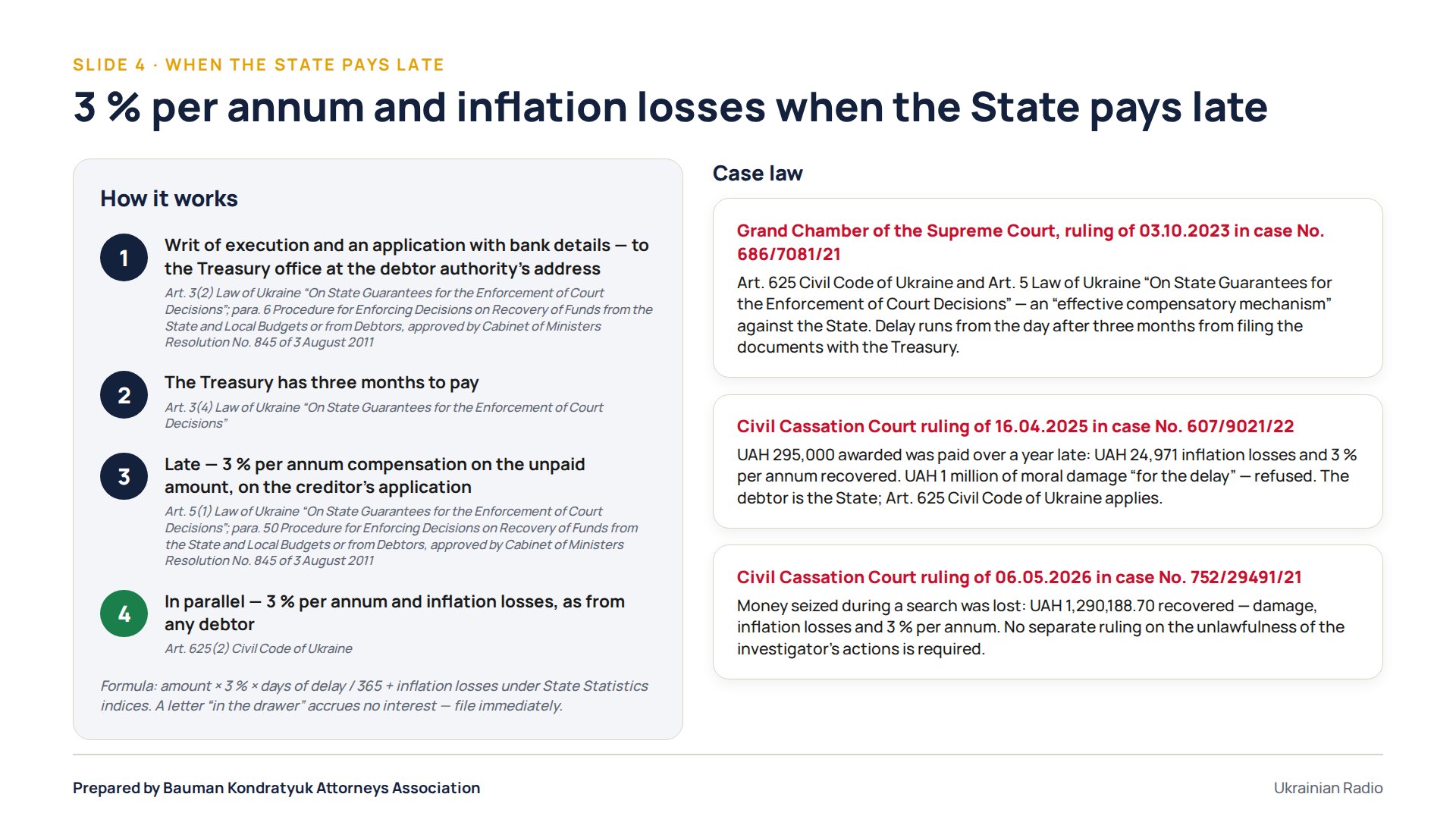
The State pays for delay like any other debtor. An award of UAH 295,000 was paid by the Treasury more than a year late. The Supreme Court confirmed that inflation losses and 3 % per annum under Article 625 of the Civil Code accrue on such a debt: UAH 24,971 in inflation losses plus 3 % per annum were recovered, while a further UAH 1 million claimed as moral damage “for the delay” was refused (ruling of the Civil Cassation Court of 16 April 2025 in case No. 607/9021/22). The underlying position that Article 625 and the Law “On State Guarantees for the Enforcement of Court Decisions” together form an “effective compensatory mechanism” against the State was laid down by the Grand Chamber of the Supreme Court in its ruling of 3 October 2023 in case No. 686/7081/21: the delay runs from the day after the three-month period following submission of the documents to the Treasury expires.
Slides prepared for the broadcast
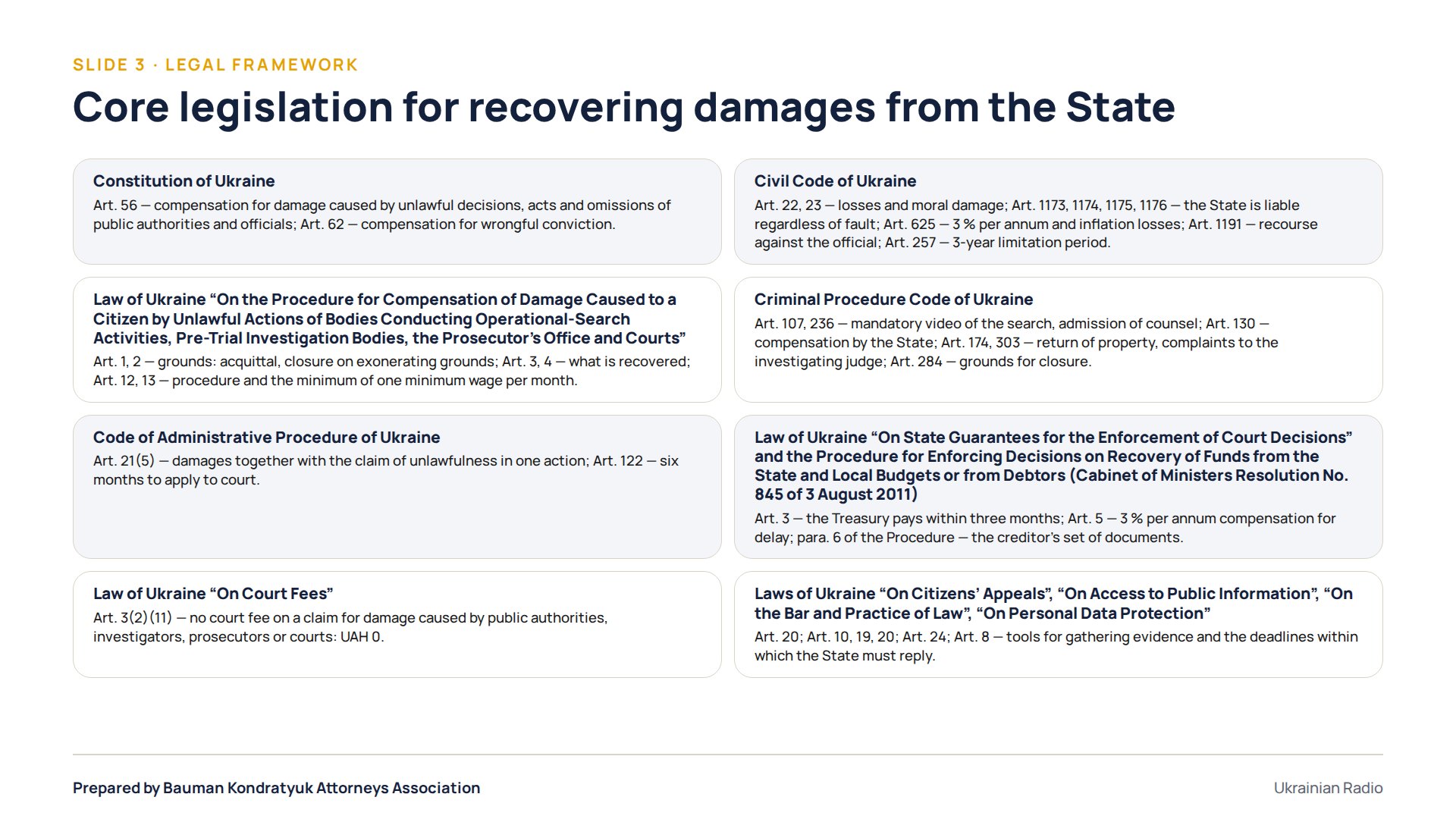
Bauman Kondratyuk Attorneys Association prepared six slides specifically for the programme: the heads of damage, the ways of obtaining information from the State, the core legal framework, the mechanism of 3 % per annum and inflation losses with references to case law, the elements of proof, and the step-by-step procedure for presenting a judgment for enforcement. Browse the carousel — each slide opens at full size.
Prepared by Bauman Kondratyuk Attorneys Association for the «Tvoye Pravo» programme on Ukrainian Radio.
Key takeaways for citizens and businesses
No court fee is payable on a claim for damage caused by public authorities, investigators, prosecutors or courts (Article 3(2)(11) of the Law “On Court Fees”); the limitation period is three years (Article 257 of the Civil Code); and the fault of the individual official does not need to be proven. Yet the right to compensation is realised only by those who, from day one, document every fact from three sources — a document issued by the State, an independent document (a valuer, a doctor, a bank, an employer) and their own contemporaneous record — who never sign a “no claims” acknowledgement when property is returned, and who obtain the writ of execution immediately after the judgment enters into force and lodge it with the Treasury. Three months after a complete set of documents is filed, every day of delay entitles the creditor to 3 % per annum compensation under the Law “On State Guarantees for the Enforcement of Court Decisions” and to inflation losses plus 3 % per annum under Article 625 of the Civil Code.
“The State is liable for the outcome, not for the intentions of its officials. But it pays only those who can prove every hryvnia with a document. A single signed ‘no claims’ line can close the door on compensation for an entire business.”
Yurii Bauman, Managing Partner, Bauman Kondratyuk Attorneys Association, on Ukrainian Radio
Where to listen and watch
The full recording is available in the Ukrainian Radio archive: «Tvoye Pravo», broadcast of 20 September 2026 (39 min, in Ukrainian). A summary with the key figures from the programme and all six slides has been published on the firm’s Instagram page: slide carousel and Reels video.
If your situation resembles those discussed on air — unlawful criminal prosecution, property seized and not returned, or a court judgment the State has failed to honour — contact us through the contact form or at office@bkadvisers.com.ua. An initial consultation allows us to assess which evidence already exists and which can still be gathered.
Sources and legislation referred to in the broadcast
Broadcast: Ukrainian Radio, «Tvoye Pravo», 20 September 2026, archive recording.
Case law: Grand Chamber of the Supreme Court, ruling of 3 October 2023 in case No. 686/7081/21; Civil Cassation Court of the Supreme Court, rulings of 16 April 2025 in case No. 607/9021/22, 17 September 2025 in case No. 461/6351/23, 6 May 2026 in case No. 752/29491/21, 27 May 2026 in case No. 346/1943/25, 1 July 2026 in case No. 522/759/25 and 29 July 2026 in case No. 757/20448/22-ц (Unified State Register of Court Decisions).
Legislation: Constitution of Ukraine (Art. 56, 62); Civil Code of Ukraine (Art. 22, 23, 257, 625, 1173–1176, 1191); Law of Ukraine “On the Procedure for Compensation of Damage Caused to a Citizen by Unlawful Actions of Bodies Conducting Operational-Search Activities, Pre-Trial Investigation Bodies, the Prosecutor’s Office and Courts”; Law of Ukraine “On State Guarantees for the Enforcement of Court Decisions”; Procedure for Enforcing Decisions on Recovery of Funds from the State and Local Budgets or from Debtors (Cabinet of Ministers Resolution No. 845 of 3 August 2011); Criminal Procedure Code of Ukraine; Code of Administrative Procedure of Ukraine; Civil Procedure Code of Ukraine; Law of Ukraine “On Court Fees”; Law of Ukraine “On Citizens’ Appeals”; Law of Ukraine “On Access to Public Information”; Law of Ukraine “On the Bar and Practice of Law”.